Neighbors
Looking out for one another and keeping residents informed about matters affecting the community.
Ellicott City, Maryland
A neighborhood shaped by history, nature, and generations of neighbors who have called Chestnut Hill Estates home.
Who We Are
Chestnut Hill Estates Community Association (CHECA) is a volunteer community organization serving the residents of Chestnut Hill Estates.
CHECA helps neighbors stay informed, share useful community information, connect with local resources, and maintain the strong sense of community that makes Chestnut Hill Estates a special place to live.
CHECA is a community organization — not an HOACommunity notices, events, newsletters, and important local information.
A central place for neighbors and community information.
Local services, parks, schools, resources, and the history of the neighborhood.
What Matters Here
Chestnut Hill Estates is more than a collection of homes. It is a neighborhood connected by people, place, shared history, and the natural landscape around us.
Looking out for one another and keeping residents informed about matters affecting the community.
Building relationships that make a neighborhood feel welcoming, familiar, and connected.
Appreciating the trees, open spaces, parks, and Patapsco landscape that surround our community.
Preserving the character, history, and sense of place shared by generations of Chestnut Hill Estates residents.
Our History
The story of Chestnut Hill Estates begins long before the neighborhood itself was built. Much of the present community lies within land once known as Chestnut Hill Farm, the property that appears to have given the neighborhood its name.
William and Emma Thompson purchased a 274-acre farm in 1939 and an adjoining 45 acres in 1956. Portions of the property were later sold to the Chestnut Hill Construction Company, beginning the transition from farmland to the residential community we know today.
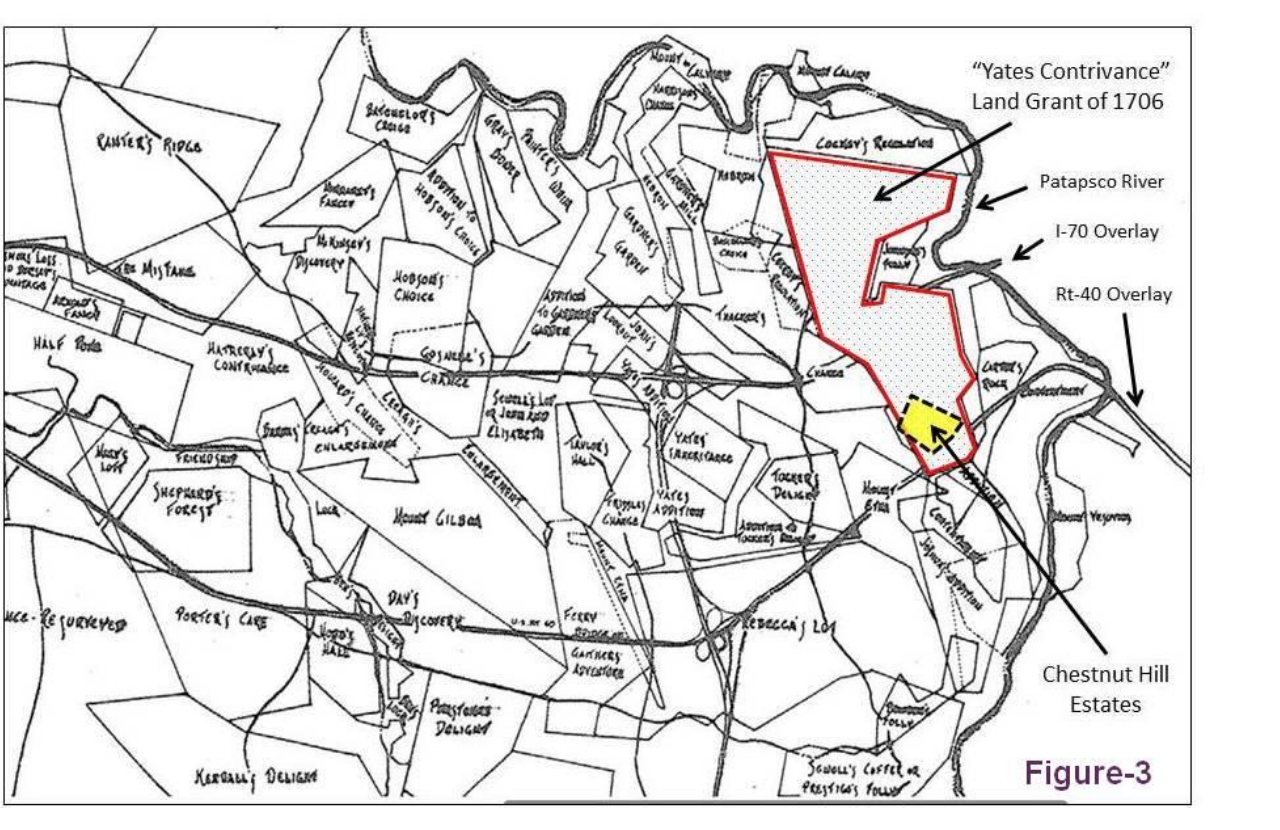
Historical research conducted with assistance from the Howard County Historical Society suggests that the area containing Chestnut Hill Estates may lie within the land grant made to George Yates known as “Yates Contrivance.” Early colonial land boundaries were imprecise, so this identification should be considered a historical interpretation rather than a modern survey determination.
The earliest known owner identified in the historical research was Benjamin Todd. The property eventually became known as Chestnut Farm and later Chestnut Hill Farm.
The earliest identified recorded sale of the farm was to Elie Clagett in 1814. Following his death, ownership passed through his family.
The farm was sold at auction to James E. Tyson. Tyson Road is believed to have been named for him. An 1877 plat later helped researchers compare the boundaries of historic Chestnut Hill Farm with the modern neighborhood.
The property was later purchased by Howard and Matilda Mann. They subsequently sold approximately 103 acres to the State of Maryland, land that became part of what is now Patapsco Valley State Park.
William and Emma Thompson purchased the approximately 274-acre Chestnut Hill Farm. They later acquired an adjoining 45 acres in 1956.
Development of Chestnut Hill Estates began with construction of three homes on Tyson Road near the Route 40 entrance. This became the first subdivision of the new community.
The first home in the new development was sold in January 1957, marking the beginning of Chestnut Hill Estates as a residential community.
Nine subdivision sections were released sequentially over approximately two decades as lots and homes were developed, gradually creating the neighborhood seen today.
Looking Further Back
Research into early Maryland land grants suggests that Chestnut Hill Estates lies within or near the boundaries of a 1706 grant to George Yates known as Yates Contrivance.
The historical map shown here is based on research into original Howard County land grants. Modern landmarks, including Interstate 70, Route 40, the Patapsco River, and Chestnut Hill Estates, were overlaid to help visualize the relationship between the old land grant and the present-day area.
Chestnut Hill Estates
From early Maryland land grants and Chestnut Hill Farm to the neighborhood that grew here beginning in the 1950s, the landscape has changed dramatically. What continues is a strong connection between people, place, nature, and community.